Running Adobe’s 1991 PostScript Interpreter in the Browser
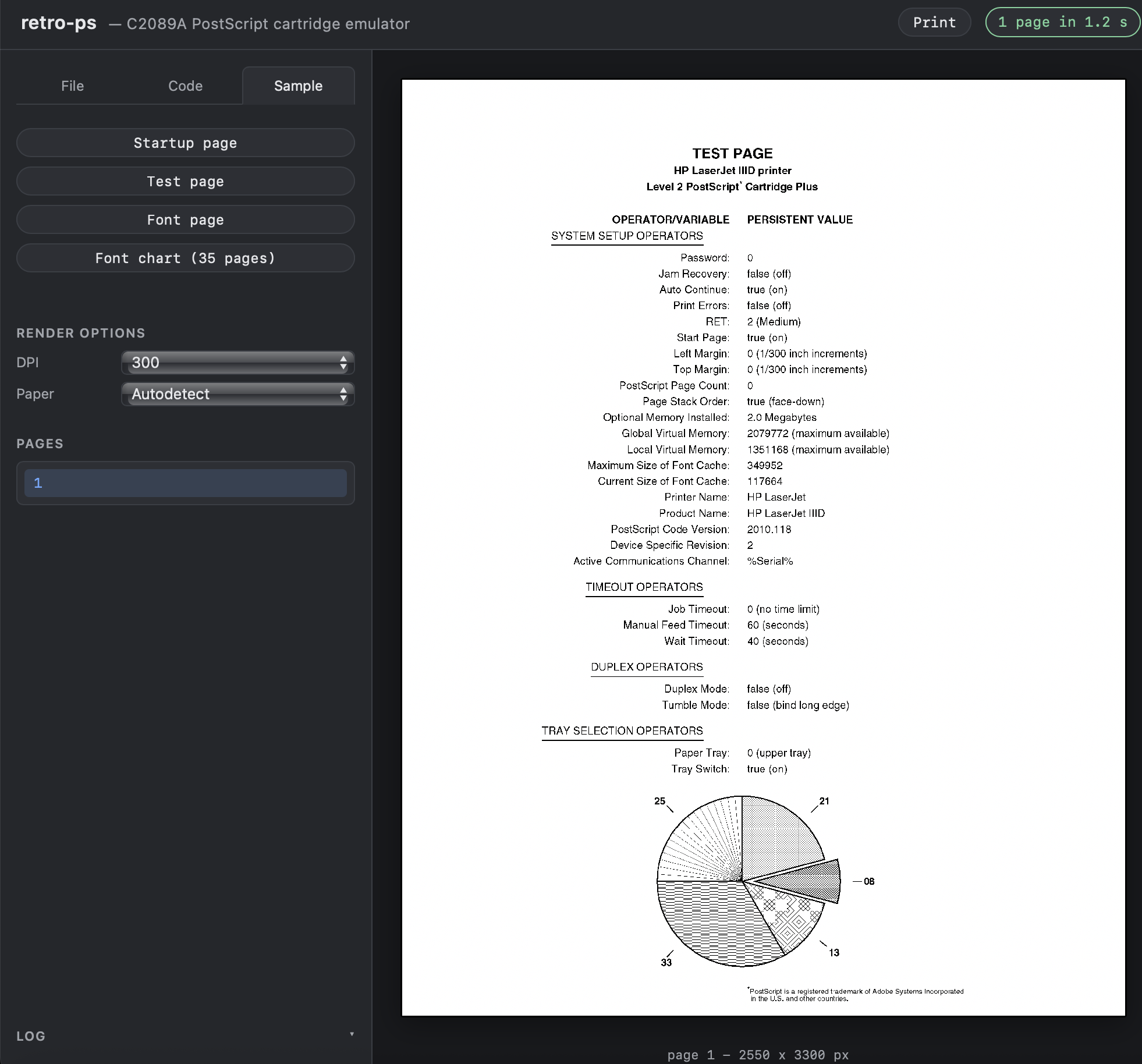
The HP C2089A “PostScript Cartridge Plus”, a 1991 add-on for the LaserJet II/III, adds PostScript Level 2 support through Adobe’s own reference interpreter (version 2010.118) on a 2 MB ROM.
Some Assembly Required
The HP C2089A “PostScript Cartridge Plus”, a 1991 add-on for the LaserJet II/III, adds PostScript Level 2 support through Adobe’s own reference interpreter (version 2010.118) on a 2 MB ROM.
In this episode of computer archeology, we deconstruct a very interesting case of borrowing code from multiple places – but first try this D64 disk image with any Commodore 64 emulator or a real C64:

The Hypervisor.framework user mode virtualization API introduced in Mac OS X 10.10 (Yosemite) cannot only be used for toy projects like the hvdos DOS Emulator, but is full-featured enough to support a full virtualization solution that can for example run Linux.
Since Version 10.10 (Yosemite), OS X contains Hypervisor.framework, which provides a thin user mode abstraction of the Intel VT features. It enables apps to use virtualization without the need of a kernel extension (KEXT) – which makes them compatible with the OS X App Store guidelines.
There are a lot of web-based computer emulators out there for ancient machines – the Commodore 64 and MSX home computers or the more exotic Space Invaders arcade machines. Such emulators are nice to play with but they are incomplete – they lack an Input/Output subsystem.
I just did a Lightning Talk at the 26th Chaos Communication Congress 26C3 about our new project “libcpu”, and it has already been picked up by Golem.de and reddit.com, so I might as well announce it here:
It is a good time for statically recompiled versions of BASIC from old computers. First there was Apple I BASIC. Then came Commodore BASIC. Now, due to overwhelming demand, we’re proud to release TI-99/4A BASIC. For those unfamiliar the TI-99/4A was a home computer by Texas Instruments released in 1981. Unusually for the time it had a 16-bit CPU: the TMS9900.
Operating system vendors face this problem once or twice a decade: They need to migrate their user base from their old operating system to their very different new one, or they need to switch from one CPU architecture to another one, and they want to enable users to run old applications unmodified, and help developers port their applications to the new OS. Let us look at how this has been done in the last 3 decades, looking at DOS/Windows, Macintosh, Amiga and Palm.
Update: The source is available at github.com/mist64/cbmbasic