Feed in Rogue Signal Here

Sometimes it makes sense to label a surveillance camera.
Apple Lisa Operating System Reference Manual (PDF, 1983)

The Apple Lisa from 1983 was the first consumer-class computer with a graphical user interface and significantly more advanced than the 1984 Macintosh, which had a similar UI, but a comparatively primitive underlying OS. Here, I present a searchable PDF of the rare “Operating System Reference Manual for the Lisa” (1983), as well as a quick overview of the OS and how it compares to UNIX.
Tripos, the Roots of AmigaDOS

The core of the Amiga Operating systems consists of the three major components Exec (scheduling, memory management, IPC), Intuition (GUI library) and AmigaDOS (process and file management). AmigaDOS is based on the Tripos operating system which Commodore bought because development of their own DOS subsystem failed to meet deadlines. In this article, I am presenting searchable PDFs of the very rare Tripos manuals (638 pages) as well as the AmigaDOS manual (304 pages). Comparing the two documents will share some insight in the relationship between Tripos and Amiga OS.
Reverse-Engineering DOS 1.0 – Part 2: IBMBIO.COM
Update: The source is available at github.com/mist64/msdos1
Reverse-Engineering DOS 1.0 – Part 1: The Boot Sector
Update: The source is available at github.com/mist64/msdos1
The 6502 in "The Terminator"

In the first Terminator movie, the audience sees the world from the T-800’s view several times. It is well-known that in two instances, there is 6502 assembly code on the T-800’s HUD, and many sites have analyzed the contents: It’s Apple-II code taken from Nibble Magazine. Here are HD versions of the shots, thanks to Dominik Wagner:
The History of OS Migration
Operating system vendors face this problem once or twice a decade: They need to migrate their user base from their old operating system to their very different new one, or they need to switch from one CPU architecture to another one, and they want to enable users to run old applications unmodified, and help developers port their applications to the new OS. Let us look at how this has been done in the last 3 decades, looking at DOS/Windows, Macintosh, Amiga and Palm.
The Easiest Way to Reset an i386/x86_64 System
Try this in kernel mode:
LodgeNet Reverse Engineering

Many hotels (at least in the USA) equip their room TVs with a “LodgeNet” entertainment system. The TV will show regular free television channels, but also have an interactive channel controlled by the remote that features video on demand and video games.
Bringup History of Mac OS X

The heritage of different operating systems has been discussed many times. Mac OS X includes code from Mach and BSD, AmigaOS is based on TRIPOS, MS-DOS is a CP/M-86 clone and Windows NT is modeled after VMS. But what machines and operating systems were used for cross-compilation and bringup of these systems? In order to find this out about Mac OS X, I talked to a few people working at NEXT and Apple, and people that worked on Mach and BSD.
cbmbasic 1.0 with Plugins
I moved cbmbasic development to SourceForge and released version 1.0, which has the following added features:
Amiga/Lorraine Mugs

Every touristy place has them: Souvenirs with given names on them. If you have an uncommon name, or a friend with an uncommon name, you might look through the whole collection – and notice that they have generic ones like “#1 FRIEND” (i case you really don’t find your friend’s name), and, sometimes, generic ones in Spanish.
Zuse Z1 at the Deutsches Technikmuseum

My last blog post showed the Zuse Z3 (1939-1941), the world’s first working digital Turing-complete computer. Let’s go back two more steps: The Zuse Z1 (1936-1938) shared its design with the Z3: It read its program from punched film and used floating point as its internal representation of numbers. But since it was all mechanical, it never worked reliably.
Zuse Z3 at the Deutsches Museum

The Z3 by Konrad Zuse was the world’s first working digital Turing-complete computer. It did floating point arithmetic, had two registers accessible to the programmer, was microcoded, and clocked at about 5 Hz.
Archimedes Operating System (PDF)

Amiga & Supergrips

This article is in German, since it is about the German TV show “Supergrips” and how the scoreboard was implemented.
The Ultimate Commodore 64 Talk: Pushing Keynote to its Limits
Download the Apple Keynote 08 presentation.
The Ultimate Commodore 64 Talk @25C3
Update: Video recording available.
Copland D9 Booting
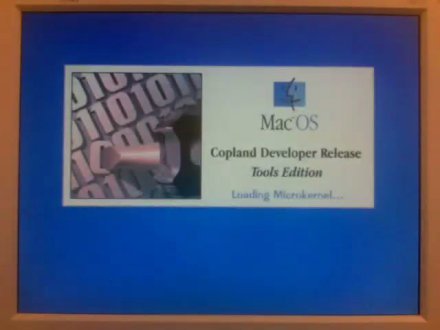
Click on the image for a video of Copland D9 (the first developer release; the second one being D11E4), booting a bit, then hanging. It is running on a Power Macintosh 6100.