Final Cartridge III Monitor for the TED

In my quest to make the C16 more usable, i.e. more like the environment I’m used to, i.e. a C64 with a Final Cartridge III, I’ve ported the Final Cartridge III monitor to the TED series (C16, C116, Plus/4).
C64 Keyboard Layout for the C16

The Commodore 16 is an interesting machine, but the keyboard layout is infuriating. The cursor keys are at an awful place and… and… and… well, it just isn’t the C64 layout I’m used to!
Analyzing the ROMs of Third Party Disk Drives for the C64
Most Commodore 64 users had a 1541 disk drives, but there were always also third part options. Most of them claimed full 1541 compatibility, which sounds impossible without using the same ROM. Let’s analyze the ROMs of some third party drives!
Reconstructing the Unreleased C128 ROM Update
The C128 source dump over at zimmers.net that appeared recently contains source for a version 2 kernel, which was never released. The known versions are 0 and 1. Let’s see whether we can reconstruct the ROM image!
Original Commodore Source Code Collection
Over the years, the ROM source code of many Commodore computers and peripherals has appeared. I have been collecting them in a git repository here:
Commodore Peripheral Bus: Part 3: Commodore DOS

In the series about the variants of the Commodore Peripheral Bus family, this article covers the common layer 4: The “Commodore DOS” interface to disk drives.
Commodore Peripheral Bus: Part 2: Bus Arbitration, TALK/LISTEN

In the series about the variants of the Commodore Peripheral Bus family, this article covers the common layer 3: the bus arbitration layer with the TALK/LISTEN protocol.
Commodore Peripheral Bus: Part 1: IEEE-488

In the series about the variants of the Commodore Peripheral Bus family, this article covers the lowest two layers (electrical and byte transfer) of the IEEE-488 bus as found on the PET/CBM series.
Commodore Peripheral Bus: Overview

The well-known Serial Bus (aka Serial “IEC” Bus) of the Commodore 64 that connects to disk drives such as the 1541 is just one variant of a whole family of busses and protocols used by the line of 8 bit Commodore machines from the PET to the C65. This is the first article of a multi-part series on the Commodore Peripheral Bus family.
Das neue Commodore 64 Intern Buch [PDF]

Announcement: The Ultimate Mars Rover Onboard Computer Talk

Daniel Jilg will present “The Ultimate Mars Rover Onboard Computer Talk”, the 7th talk in the “Ultimate Talk” series, at the 35th Chaos Communication Congress (35C3) on 2018-12-29 at 19:10 CET.
Archiving C64 Tapes Correctly
It’s pretty simple to archive Commodore 64 tapes, but it’s hard if you want to do it right. Creating the complete archive of the German “INPUT 64” magazine was not as easy as getting one copy of each of the 32 tapes and reading them. The tapes are over 30 years old by now, and many of them are hardly readable any more.
INPUT 64 Magazine Complete Archive
The complete archive of the German Commodore 64 magazine INPUT 64 (PDF, tapes, disks) is now available here.
Video of a Real C64 Defragmenting a Disk
Here is a 21 minute video of defrag1541 running on a real Commodore 64 – with sound!
A Visual Defragmenter for the Commodore 64

For decades, PC users have been able to relax by watching the computer defragment a disk. Now C64 users can do the same! Introducing “defrag1541”, a disk defragmentation tool for C64 and 1541.
C64-Artikel in der c't Retro 2018

This post is about articles I wrote for the c’t magazine in German language. The post is therefore in German.
Repairing a Commodore 1084S Power Switch

The power switch of the Commodore 1084S tends to break easily. To replace it, you will need a standard “Preh TV3” switch (which can be found online), a screwdriver, a soldering iron, desoldering braid, and some basic soldering skills.
A Minimal C64 Datasette Program Loader
The Commodore Datasette recording format is heavily optimized for data safety and can compensate for many typical issues of cassette tape, like incorrect speed, inconsistent speed (wow/flutter), and small as well as longer dropouts. This makes the format more complex and way less efficient than, for example, “Turbo Tape” or all other custom formats used by commercial games. Let’s explore the format by writing a minimal tape loader for the C64, optimized for size, which can decode correct tapes, but does not support error correction.
Commodore 64 BASIC inside your USB Connector
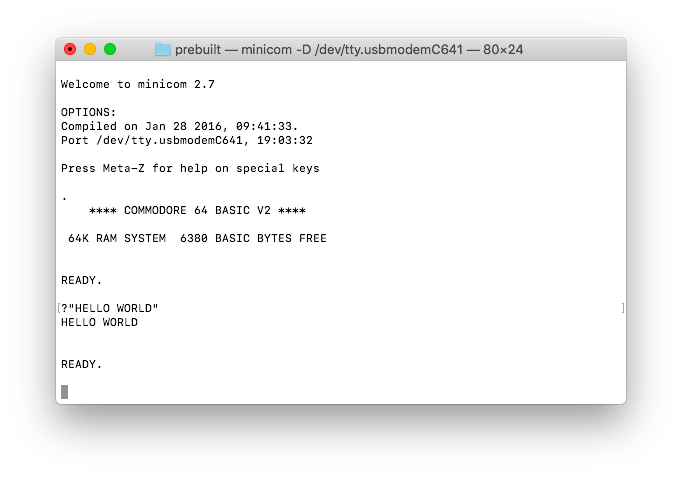
Tomu is a super cheap Open Source Hardware 24 MHz ARM computer with 8 KB of RAM and 64 KB of ROM that fits into your USB connector! Of course I had to put Commodore 64 BASIC on it, which can be accessed through the USB-Serial port exposed by the device.
Making Of "Murdlok", the new old adventure game for the C64
Recently, the 1986 adventure game “Murdlok” was published here for the first time. This is author Peter Hempel‘s “making-of” story, in German. (English translation)